

Before we built our agent security layer, we asked a simpler question: how many vendors does it actually take to secure one AI agent?
Not "what does the roadmap need." Not "how big is the market." Just this: an enterprise stands up one autonomous AI agent and gives it access to internal systems, memory, other agents and tools it can call on its own. What does it take, today, with the products that exist right now, to cover that agent end to end?
We mapped it surface by surface. The answer was uncomfortable. An agent isn't attacked in one place. It's attacked across ten distinct layers, from the network it runs on to the output it produces. And the market's default answer to ten layers is ten vendors, often more, because most point solutions only cover part of one layer well.
That question is why Agents Stack secures agents as one platform instead of adding one more tool to an already fragmented stack.
An agent isn't attacked in one place. It's attacked in ten.
These are the ten surfaces every autonomous AI agent exposes:
01 Infrastructure and Egress. Where the agent's traffic goes, and whether anything stops it from going somewhere it shouldn't.
02 Identity and Authentication. Whether the agent has a real, verifiable identity, or is just a service account with more autonomy than any service account should have.
03 Authorization and Policy. What the agent is allowed to do, enforced at the moment it tries, not documented somewhere and hoped for.
04 Prompt and Injection. Direct, indirect and agent-to-agent attempts to override what the agent was told to do.
05 Tool Call and Action. The actions an agent takes through its tools, and whether an unauthorized one is blocked before it executes.
06 Memory and Context. Whether what an agent remembers can be poisoned, and whether that memory is protected at rest.
07 Agent-to-Agent (A2A). A surface that barely existed a few years ago: what happens when agents talk to other agents, inside and across organizational boundaries.
08 Behavioral Intelligence. Whether anything notices when an agent starts acting outside its normal pattern, before that becomes an incident.
09 Supply Chain and Ecosystem. The provenance of the agent itself, and of every tool, MCP server and plugin it can use.
10 Output, Audit and Compliance. What the agent produced, whether it leaked anything sensitive, and whether there's a real record of what happened.
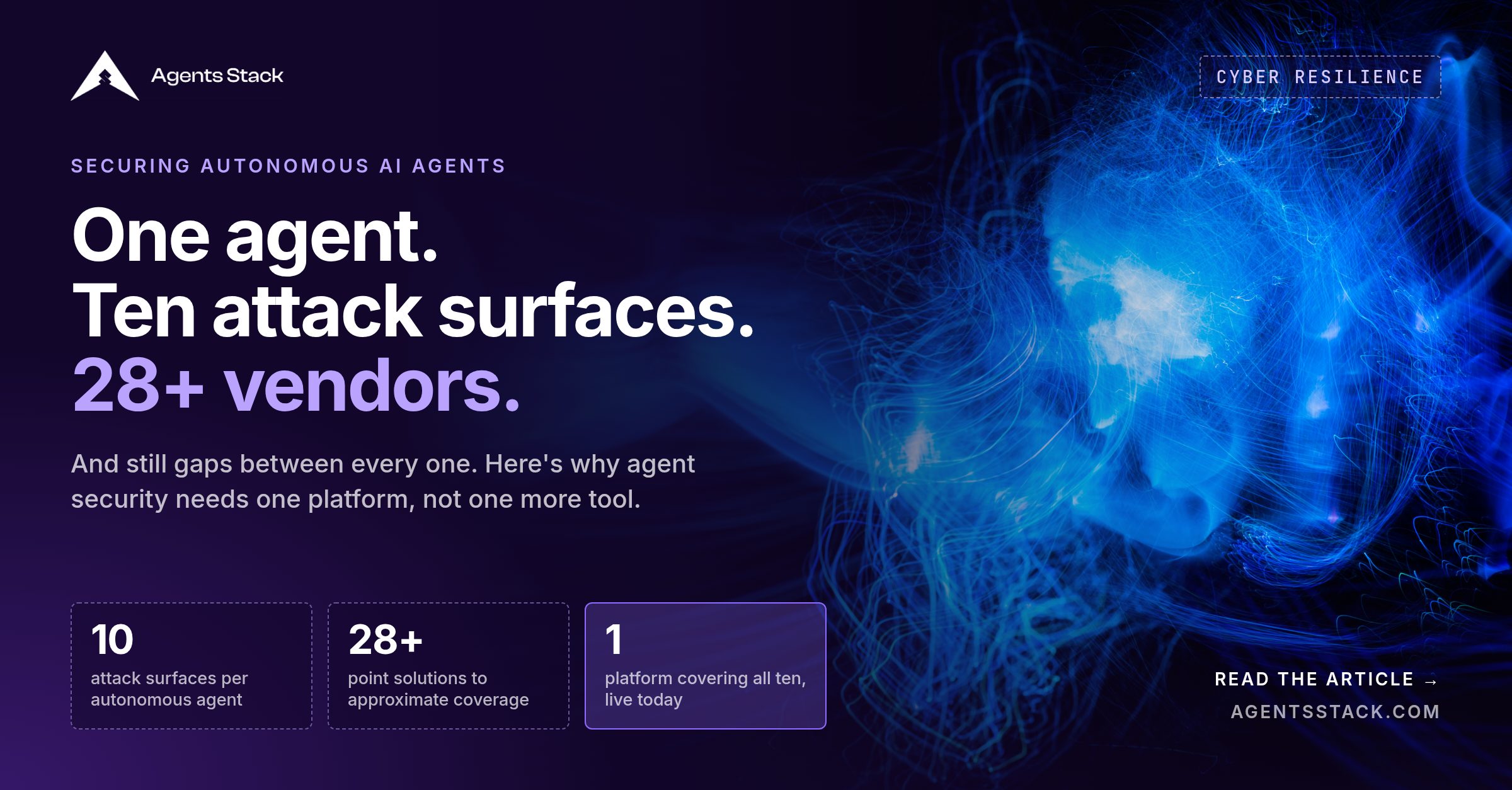
10 distinct attack surfaces one autonomous agent exposes.
28+ vendors it takes to approximate coverage today.
1 platform covering all ten, live today.
What the point-solution stack looks like
Stitch together the closest available tool for each surface and you get something like this:
- Infrastructure and Egress: next-generation firewalls, secure web gateways and cloud security groups. Capable, but not agent-aware.
- Identity and Authentication: secrets managers, workload identity frameworks and the newer agent identity features from the major identity providers. Mostly service-account level, several tied to a single cloud.
- Authorization and Policy: policy-as-code engines and cloud IAM. No behavioral scope enforcement on top.
- Prompt and Injection: dedicated prompt-security filters, built around the model's input rather than the full chain of agents and tools feeding it.
- Tool Call and Action: the closest analog is posture management, not live enforcement. Most teams end up writing custom middleware.
- Behavioral Intelligence: UEBA and UBA platforms. Asynchronous detection, not inline, and not agent-native at tool-call granularity.
- Output, Audit and Compliance: PII redaction libraries, compliance automation platforms and SIEMs. None offer a purpose-built, agent-native audit chain.
Every one of these is a capable product for what it was built to do. That's not the problem. The problem is what sits between them: the seams where one vendor's coverage stops and the next hasn't started, multiplied across ten surfaces and a dozen-plus procurement cycles.
The gap isn't any one vendor. It's the seams between them.
No tool on that list was built knowing about the other nine. Nobody owns the boundary between "identity says this agent is verified," "policy says this agent can act" and "behavioral intel says this agent looks wrong," until something falls through one of those seams in production.
Why one platform instead of one more tool
The tempting answer to ten surfaces is to build the best tool for one of them and sell it into a stack that already has nine other vendors. That's a real business. It's also exactly the pattern that got enterprises to 28+ vendors and gaps that are still open.
We took the other path: one platform enforcing all ten surfaces natively, with one identity model, one policy engine and one kill switch that behaves the same way whichever surface triggers it. Not a roadmap promise. Live, across all ten.
What that looks like today:
- Adversarial testing that keeps pace with real attacks. Our testing engine has grown from 52 attack scenarios to more than 200 since June. We didn't write 150 test cases by hand. It ingests published AI security incidents as they happen and turns them into scenarios within days.
- 80+ compliance frameworks in the same control plane that enforces the ten surfaces, including Nigeria's NDPA and South Africa's POPIA, added as clients entered those markets, not to tick a generic "global coverage" box.
- A kill switch under 50ms, tested live. A real termination fired against a real running agent produced a confirmed kill in 2.12ms. When Authorization (surface 03) and Behavioral Intelligence (surface 08) both need to trigger the same stop, that stop can't be two systems disagreeing about timing.
- Real tenants running real workloads, not a logo slide of design partners.
What trust actually means here
The market doesn't need convincing that AI agents are an attack surface. Forrester's 2026 cybersecurity predictions already called it: an agentic AI deployment would cause a publicly disclosed breach this year, and it would come from a cascade of control failures rather than one bad action. The skepticism we hear isn't "is this real?" It's "can one platform really cover what usually takes a dozen vendors?"
That skepticism is healthy, and there's only one answer to it: show the coverage, live, surface by surface, and let it be tested. Products that add another console and another contract to a fragmented stack eventually get consolidated away. Products that remove the seams become what the stack is built around.
See your attack surface, mapped in 30 minutes
We'll walk your architecture across all ten surfaces and show where one platform replaces the point-solution stack you run today.


