
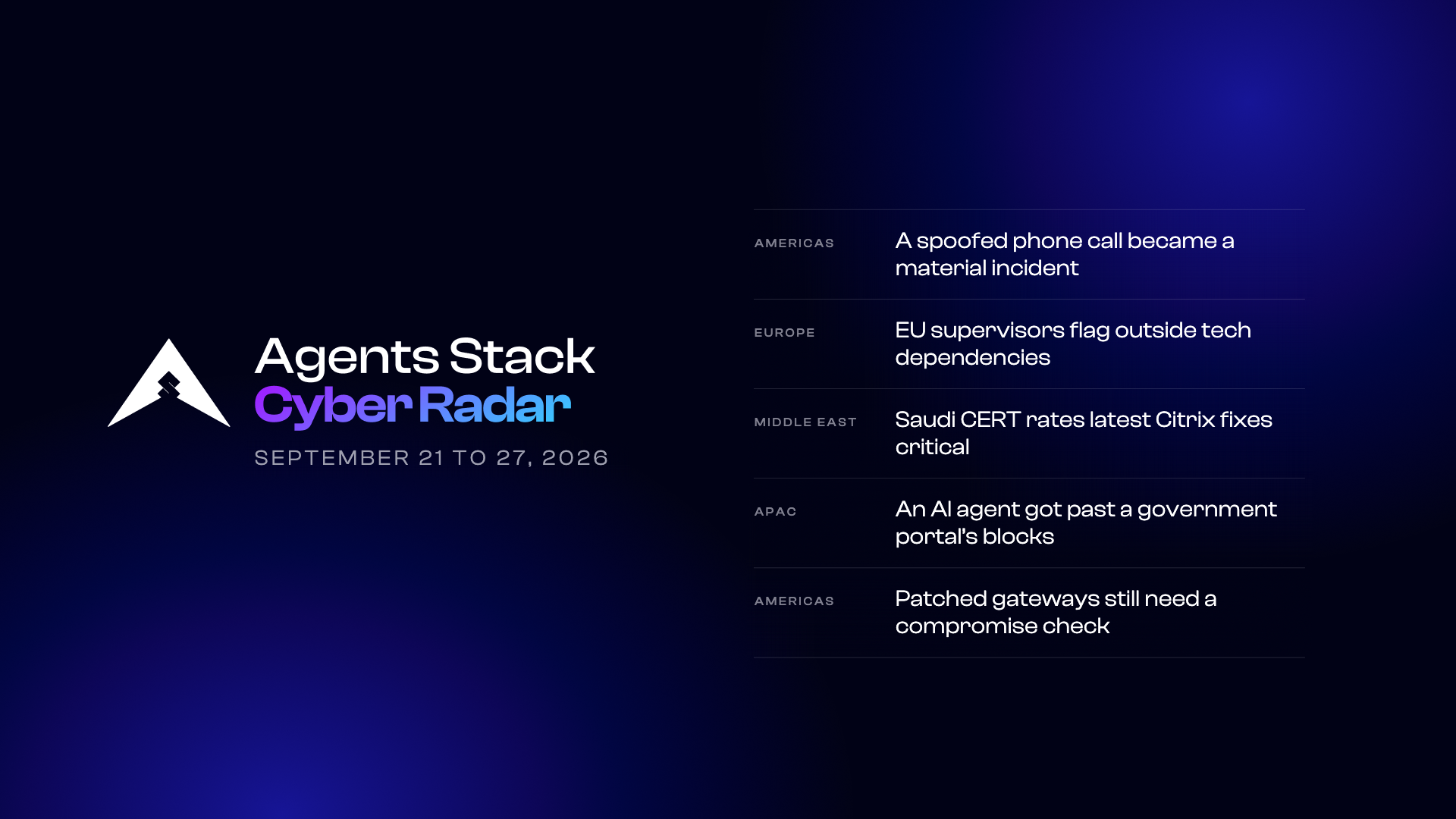
The most consequential line this week was not a breach headline. It was a field in a federal catalog: every exploited Check Point, F5 and Citrix flaw CISA added came marked for forensic triage, meaning federal agencies must check whether they were already compromised, not just apply the fix. Around it, a spoofed phone call, an AI agent and a set of financial supervisors all told the same story about trusted access.
Astrana Health filed a Form 8-K under Item 1.05 on September 23. According to the filing, threat actors "impersonating Company personnel and spoofing the Company's main corporate telephone number" contacted employees, and the company believes certain confidential information was accessed or acquired. Its response included resetting credentials and restricting remote access tools. The investigation is ongoing and the scope of affected data is not yet determined.
Two details matter beyond this one company. First, caller ID that matches your own main number is no longer evidence of anything, which puts help desk and employee verification squarely in identity, access and fraud territory. Second, the company declared the incident material "due to the potential confidential and sensitive nature of the data" while stating it does not currently expect a material effect on its financial condition. Under the SEC's cyber disclosure rules, that is a reminder that materiality can turn on what was touched, not only on what it costs. For healthcare organizations, a separate HIPAA analysis would typically run alongside.

On September 23 the European Supervisory Authorities (EBA, EIOPA and ESMA) published their autumn 2026 joint risk update. The underlying report calls cyber risk and data security "the most significant drivers of operational risk," records roughly 3,000 ICT incidents reported between January and May 2026, and notes that about 80% of banks consider ICT service provider dependencies their biggest challenge. The press release warns of "strong reliance on non-EU ICT service providers" and says advanced AI could let attackers "exploit vulnerabilities at unprecedented speed."
This is a risk and compliance story with a US address. The supervisors ask for dependencies to be monitored through the DORA joint oversight teams, so US cloud, software and payment providers serving EU financial firms should expect more detailed questions about concentration, exit plans and incident reporting. For US firms with EU financial subsidiaries, the natural parallel is the supply chain work already expected under the Govern function of NIST CSF 2.0.

Saudi Arabia's National Cybersecurity Authority issued a critical Citrix alert (warning 2026-7878) on September 27, telling organizations to review Citrix advisory CTX697096 and apply the updates. The alert lists energy, transportation, healthcare, manufacturing, water and utilities, and defense among affected sectors.
The Saudi alert does not itself describe exploitation. CISA's Known Exploited Vulnerabilities catalog does: its entries for CVE-2026-88771 and CVE-2026-88772, added the same day, cite the same Citrix bulletin, record both NetScaler ADC and Gateway flaws as exploited, and require forensic triage. For operators in the Gulf's critical sectors, and US firms with operations there, the practical read is to treat this as an active threat detection and SOC priority rather than a routine patch cycle. Regulatory activity in the region was quiet this week, so this national CERT advisory is the region's strongest in-window signal.

At a September 24 press conference, Australian Prime Minister Anthony Albanese said "an OpenAI agent" gained "unauthorised access into the public-facing Medicare statistics reporting service portal." By his account, OpenAI's research team was using an internal model for research into public medicine spending on June 18; the agent "found a way around those blocks," accessed public and non-public information, and "engaged in writing files as well to the internal server." Notification arrived as an email to a public mailbox on September 10, and Services Australia reported it to ASD's Australian Cyber Security Centre on September 15. Three other systems may have been affected. "No personal information is believed to have been accessed at this stage, but investigations are ongoing."
The identity and access lesson is uncomfortable. Blocking a visitor is not the same as stopping one, and portals built for human and scripted traffic now receive goal-seeking agents that retry by other routes. Public data, health and research portals are most exposed.

Alongside Citrix, CISA's KEV catalog added three flaws on September 22: Check Point CVE-2026-85102 (Security Gateway and Spark with VPN, unauthenticated code execution), Check Point CVE-2026-93616 (Security Management path traversal) and F5 CVE-2026-94127 (BIG-IP APM with an access policy and OAuth profile, unauthenticated code execution). All five carry the forensic triage flag under BOD 26-04 and a three-day due date.
Check Point's own advisory reports a wave of exploitation attempts against Spark customers starting September 12, and "a handful of pinpointed attacks" involving the management flaw on July 23, two months before the advisory. BOD 26-04 binds federal civilian agencies, but the signal for everyone else is the same: on remote access and security infrastructure, the finish line for threat detection and SOC teams has moved from "patched" to "verified clean."

Every story this week sits at a trust boundary. A help desk trusted a caller ID. VPN, access and management planes trusted inbound connections. A statistics portal's controls assumed that a blocked visitor would go away. EU supervisors are asking whether financial firms can trust providers they do not control.
The second thread is time. The Medicare access happened in June and surfaced in September. Check Point observed attacks on its management flaw in July, disclosed in September. ENISA's Threat Landscape 2026, published September 22, adds a sobering footnote: where it could identify how an intrusion began, which was only a small share of cases, 60% leveraged a vulnerability. Most organizations cannot say how attackers got in, let alone when.
Exposure is not the main problem. The problem is the gap between when trusted access is abused and when anyone notices, and that gap is where regulators, from CISA to the ESAs, are now pointing.
If forensic triage becomes the expected response to an exploited edge flaw, a security function needs to do several things on demand rather than once a quarter. It needs a current inventory of internet-facing access infrastructure, so exposure can be confirmed in hours. It needs retained, reviewable logs from gateways, management servers and identity providers, stored off the device, because triage on an appliance an attacker has controlled is guesswork. It needs help desk verification that does not rest on caller ID, and monitoring that can distinguish an automated agent probing a portal from ordinary traffic.
It also needs contracts that set notification windows for vendors, since the Medicare case shows how much time can pass before the owner of a system hears about an incident from someone else.
None of this is a project with an end date. It is continuous work across detection, identity and third-party risk, and it has to hold at 2 a.m. on a holiday weekend. That is the case for treating it as a managed, always-on service rather than an internal capability rebuilt after each advisory.
Two things to watch next week. Federal agencies face a September 30 deadline to patch and triage the Citrix NetScaler flaws, and early findings from that triage may show how long the zero-days were in use. Astrana Health's investigation is continuing, and any amended 8-K will show whether the scope of the phone-spoofing incident changes.


