
Before we start, take a few minutes for Aanchal and Meenu's chat about Nigeria's AI challenges. The talent there is world-class, and they get into how AI can give it the structure to compete globally.
Two of the most widely deployed network platforms in enterprise use were confirmed as exploited before most customers knew a flaw existed. In both cases the federal patch window was three days. For anyone running these systems, the more useful question is no longer how fast you can patch, but what you can prove about the weeks before the patch arrived.
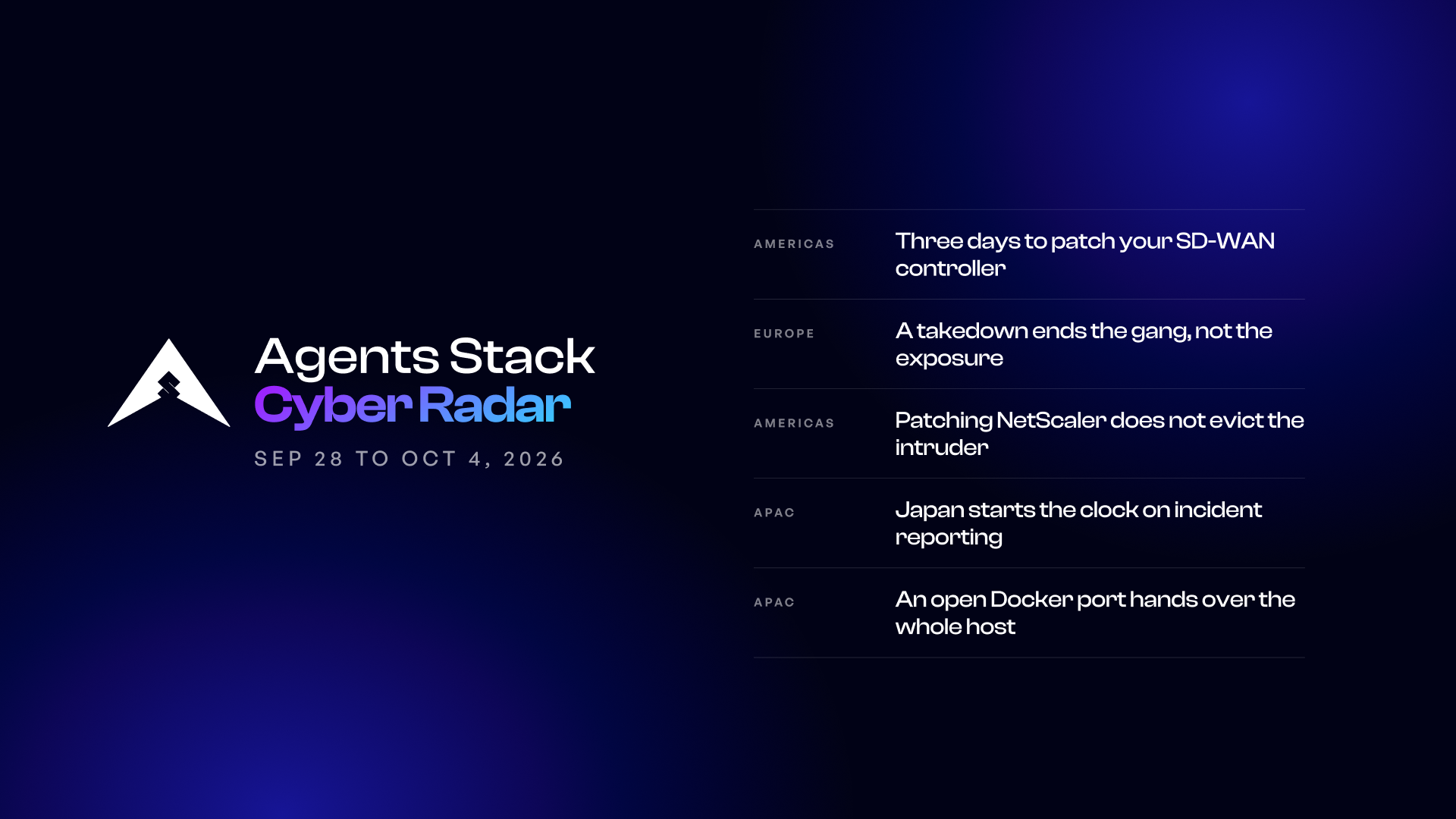
On September 30, Cisco published an advisory for CVE-2026-76504, an authentication bypass in the API of Catalyst SD-WAN Manager rated 9.8. An unauthenticated attacker can reach the system with administrator privileges. Cisco states that its incident response team became aware of active exploitation in September 2026 and that no workaround exists. Fixed releases are available for each supported branch.
CISA added the flaw to its Known Exploited Vulnerabilities catalog the same day, with a reported remediation date of October 3 for federal civilian agencies.
SD-WAN Manager is the controller for a company's wide area network, so administrative access there is access to routing and policy for every connected site. This is a threat detection and SOC story more than a patching one. It lands hardest on distributed enterprises: retail, healthcare systems, banking branch networks and manufacturers. Defense contractors working toward CMMC should expect the KEV catalog to be the yardstick assessors reach for.

Europol announced on September 30 that law enforcement had seized the servers and leak site of the KillSec ransomware group. According to Europol, three people were arrested and eight searches carried out across four European countries, at least 110 terabytes of data were secured, and the group is linked to roughly 1,000 attacks worldwide. The suspected leader is a teenager. Trade coverage of the operation reports that around half of those attacks were confirmed as successful, a figure investigators have said may change.
A takedown removes a leak site. It does not remove the fact that data left the building. For any US company that was a KillSec victim, or whose vendor was, the obligations under state breach notification laws and HIPAA are unchanged by the arrests. Seized data can also surface victims who never knew they were hit, which is where resilience and continuity planning meets legal exposure. If law enforcement contacts your organization in the coming weeks, the response plan should already exist.

On September 27, CISA issued an alert on two critical flaws in Citrix NetScaler ADC and Gateway, CVE-2026-88771 and CVE-2026-88772, both exploited as zero-days before Citrix disclosed them. That was last week's news. This week's development is what came after the patch.
By September 30, Cybersecurity Dive reported that Google Threat Intelligence Group and Mandiant assess the attackers as having state-nexus affiliations, and that Mandiant's CTO warned that upgrading alone will not remove post-exploitation access or address stolen credentials.
That is the operative point for threat detection teams. A patched appliance that was compromised in early September is still a compromised appliance. Organizations in government, financial services and healthcare, which the reporting names among those targeted, need a forensic review and credential rotation alongside the upgrade. Public companies should also be asking whether what that review finds triggers an SEC materiality assessment.

On October 1, the main operational provisions of Japan's Active Cyber Defense legislation, Act No. 42 of 2025, came into force. Based on the Cabinet Secretariat's implementation materials and legal commentary on the phased schedule, three things are now live: mandatory incident reporting to the government by designated critical infrastructure operators, government sharing of analyzed threat information with the private sector, and a confidential public-private council.
For US firms this is a risk and compliance matter with a familiar shape. Japan now joins the SEC's four business day disclosure rule and the reporting regime CIRCIA sets up for US critical infrastructure. A US multinational with a designated Japanese subsidiary may hold direct obligations. A US supplier of network or security equipment to a designated operator may find reporting duties arriving through contract. Either way, the incident response plan needs one more clock on it.

On September 30, the Cyber Security Agency of Singapore issued an advisory on a botnet campaign, tracked as CARBONATO, that targets Docker hosts whose remote API is exposed to the internet without authentication. The campaign uses legitimate Docker functionality to create a privileged container with access to the host, then establishes persistence, harvests credentials and scans for more exposed daemons.
Nothing here requires a vulnerability. It requires one configuration choice left in place. This maps to threat detection, and under NIST CSF 2.0 it is an asset and configuration management failure before it is a detection one. Software companies, cloud-native teams and any enterprise with development environments outside central IT are the exposed group.

Three of this week's five stories are the same story told on different platforms. An SD-WAN controller, an application delivery gateway and a container daemon are all management planes: systems whose job is to control other systems. Each was reachable from the internet. Each gave an attacker administrative reach in a single step.
In two of the three, exploitation came before disclosure. That changes what a patch deadline means. A three-day window measures how quickly you close the door. It says nothing about who came through while it was open, and the NetScaler reporting this week says that part plainly.
The other two stories describe what happens afterward. Japan has added a reporting duty that begins when an operator recognizes an incident. The KillSec seizure shows that an incident can come back months later as someone else's evidence. Both reward the organization that already knows what happened on its own network.
Taken together, the week describes a capability more than a control. A security function that stays ahead of this needs to do four things continuously, not at audit time.
It needs a current inventory of every management interface reachable from outside, including the ones development teams stood up. It needs to match that inventory against the KEV catalog within hours, because the federal benchmark is now days. It needs to treat every exploited-before-disclosure flaw as a possible compromise and go looking, with retained logs deep enough to cover the weeks before the advisory. And it needs to know which reporting clocks start, in which jurisdictions, the moment something is found.
None of those is hard once. Doing all four every week, across every platform, is what most internal teams are not staffed for. That gap is the case for running detection, exposure management and response as a managed service: the work is continuous by nature, and it is better done by a function built to be continuous.
Expect more detail on the NetScaler intrusions as forensic reviews complete, and watch for the first SEC filings that reference them. Boston Scientific has said it will update its outlook on October 28 following the material incident it disclosed in September, which will be an early read on how a manufacturing disruption carries through to results.


