
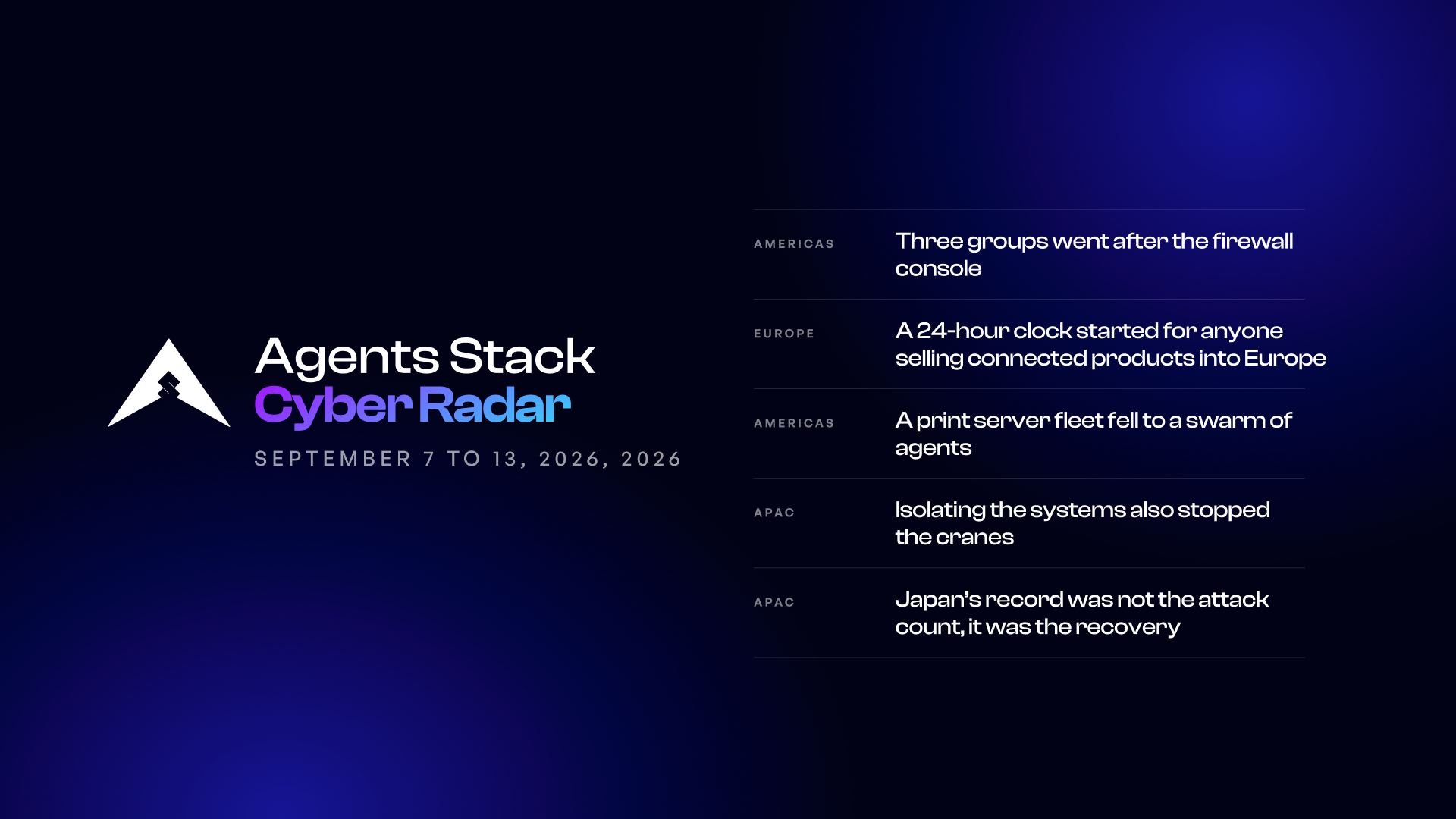
Five stories this week, and what they share is not a vendor or a threat actor. It is time. A single operator reached domain administrator at a US school in seven minutes. A new European duty starts a 24-hour clock on becoming aware of a problem. And in Japan, more than half of last half-year's ransomware victims needed over a month to restore operations.
Cisco Talos disclosed on September 9 that it is tracking active exploitation of two flaws in Cisco Secure Firewall Management Center. CVE-2026-20079 is an authentication bypass carrying a CVSS score of 10.0, letting an unauthenticated remote attacker run scripts and obtain root on the underlying operating system. CVE-2026-20316, scored 5.3, permits login through a low-privileged account and can be chained to escalate.
Talos describes three activity clusters: one harvesting credentials via a web shell and a malicious JAR file, one it assesses with high confidence has tooling overlapping with Sandworm and which deployed a Cyclops Blink variant, and one assessed with high confidence as a Qilin ransomware affiliate that encrypted selected endpoints. CISA added CVE-2026-20079 to its Known Exploited Vulnerabilities catalog the same day, with a federal deadline of September 12. It is the third FMC vulnerability to reach KEV in 2026. Most organizations monitor what their firewalls block rather than what happens to the console managing them.

From September 11, the reporting obligations in Article 14 of the EU Cyber Resilience Act apply. Manufacturers of products with digital elements must report actively exploited vulnerabilities and severe incidents through ENISA's Single Reporting Platform, which went operational the same day. The sequence runs early warning within 24 hours of becoming aware, fuller notification within 72 hours, and a final report within 14 days of a corrective measure or within a month for a severe incident.
Two details make this heavier than it reads. The duty covers products already on the EU market, not only ones shipped after the deadline. And the clock starts on awareness, not confirmation, so the reporting decision lands while the investigation is still incomplete. Any US firm placing connected hardware or software on the EU market now needs a named reporting route, an authorized representative in place, and an escalation path that runs at 24-hour speed on a weekend.

GreyNoise published research on September 9 describing a campaign in which one operator used hundreds of AI agents to exploit two chained PaperCut NG/MF flaws, CVE-2026-81578 and CVE-2026-82078. GreyNoise counts at least 440 compromised instances across 395 identified organizations in 48 countries, with education hardest hit at 204 victim organizations and the United States the largest single country at 98. It assesses the operator as likely Russian-speaking and the targeting as opportunistic.
The timings are the story. GreyNoise reports the operator went from an empty workspace to remote code execution against a real victim in under four hours, and that once the campaign launched, 11 organizations were compromised in 26 seconds. In one case a US high school went from initial access to domain administrator in seven minutes. Blackpoint Cyber reported separately on the same campaign, framing AI's contribution as a reduction in human effort rather than a novel technique. Nothing here required an unknown exploit. It required labor, and the labor was automated.

Malaysia's Port of Tanjung Pelepas confirmed a cybersecurity incident detected late on September 9 affecting its terminal operating systems. The operator isolated the affected systems as a precaution, temporarily suspending container terminal operations, and began a controlled phased restart on September 10, according to Lloyd's List. PTP handled more than 14 million TEU in 2025 and is a primary transhipment node for the Gemini Cooperation network. Maersk said it was working with the port to manage operational impact, with some vessel delays expected. A ransomware group has listed the port on a leak site, but that is a criminal claim and remains unverified.
The containment decision is the part worth sitting with. In an operational environment, isolating affected systems is both the correct security action and a decision to stop revenue. That is not a call an analyst makes alone at midnight, which is why operational technology incidents need containment authority agreed in advance.

Japan's National Police Agency released cyberthreat figures on September 10 showing 123 confirmed ransomware cases in the first half of 2026, the highest half-year total since the series began in 2020 and up seven year on year. Of those, 79 hit small and medium-sized enterprises and 31 hit large companies, across 35 of Japan's 47 prefectures. Reporting on the NPA data notes restoration took more than a month in over half of cases, nine cases caused complete business suspension, and damages exceeded 10 million yen in 60 percent of cases.
An increase of seven cases is not the headline. The recovery distribution is. A month of degraded or suspended operations is a balance sheet event regardless of whether a ransom was paid, and it is the number a board should be asking about rather than the incident count.

Three clocks ran at different speeds this week, and none were set by the same party.
Offense now runs at machine speed for commodity work. The PaperCut campaign compressed research, exploit development, targeting and mass compromise into an interval a human team could not match, using published vulnerabilities and available models. Regulation is compressing in response: the CRA's 24-hour early warning joins an already dense reporting stack, and CISA's three-day federal deadline on the Cisco flaw assumed the same urgency. Recovery has not compressed at all. Japan's figures put restoration past a month for most victims, and Tanjung Pelepas needed the better part of a day to restart a terminal.
What connects the Cisco and PaperCut stories underneath is also worth naming. Both targeted infrastructure sitting inside the trust boundary and rarely monitored as a threat surface: a firewall management console, and a domain-joined print server running with SYSTEM privileges. Neither is where detection engineering starts. Both are where privilege concentrates.
The practical consequence is that detection coverage has to extend to the systems that administer other systems, and that response has to run continuously rather than during business hours. A campaign that reaches domain admin in seven minutes does not care what time zone the analyst is in. A 24-hour clock that starts on awareness means the detection timestamp and the reporting timestamp are now the same record, which only works if someone is watching when it happens.
Most organizations do not have a staffing gap here. They have a coverage gap that appears at night and on weekends, and a set of obligations that has stopped respecting that boundary. What this week implies is continuous monitoring that includes the management plane, containment authority agreed before the incident rather than during it, and recovery tested against the month-long timeline the Japanese data shows rather than the RTO in the policy document. That is a standing operational capability, not a project, and it is what Agents Stack runs as a managed service across six cyber domains.
Cisco has signalled a broader FMC hardening release. Whether it closes the management-plane pattern or adds a fourth KEV entry to the 2026 tally is the thing to check. The first weeks of CRA filings will show whether manufacturers can meet a 24-hour clock in practice. And the PaperCut campaign is unlikely to be the last: the next one will tell us whether agent-driven exploitation generalizes past software with a large, internet-exposed install base.


